Confident release
Results for the specific spoilage organisms that matter arrive fast enough to wait for them before release, so beverages leave the plant with verified microbial status instead of on a calculated risk.
 Ampliora 4.7
 Ampliora 4.7
Featured technology
Advanced RNA technology for ultra-fast results
Featured solutions
See allIndependently validated to ISO 16140-4
A single fast, reliable molecular test to detect all key spoilage microorganisms in beverages to ensure product confidence and operational efficiency for beverage plants worldwide.
LEARN MORE
AMPLIORA 4.7 · LOW-PH MICROORGANISMSAmpliora 4.7 Low-pH Microorganisms is the first molecular solution for rapid, simultaneous detection and identification of all key spoilage microorganisms in carbonated soft drinks, juices and other low-pH beverages. It enables faster quality decisions, improved operational efficiency, lower testing costs, and greater confidence across beverage operations.
Multiplex detection
Assay coverageTime to result
Time gained
earlier release than the reference culture method — corrective action starts while it's still one batch.
Validated matrices
Validated for use in the following beverage matrices.
Validation summary
ISO 16140-4Independently validated to ISO 16140-4, the international standard for alternative microbiological methods, against the reference culture method.
True positives correctly detected
True negatives correctly cleared
Overall agreement vs. reference
ADVANTAGES
AMPLIORA 4.7 · IMPACTWhat this kit changes for your production line — fewer stoppages, lower outbreak risk and leaner inventory.
Results for the specific spoilage organisms that matter arrive fast enough to wait for them before release, so beverages leave the plant with verified microbial status instead of on a calculated risk.
By detecting only the relevant spoilage organisms, the panel clears unaffected batches quickly, freeing product that traditional broad-spectrum holds would have kept waiting unnecessarily.
Slow results delay corrective action and let contamination spread across batches. Results in under 52 hours enable fast corrective action that prevents cross-contamination before it compounds.
Fewer products sitting in quarantine means less warehousing and refrigeration tied up in hold inventory, turning faster release directly into lower carrying cost.
How it compares
| Feature | TAAG | What it means for you | Leading PCR | Traditional |
|---|---|---|---|---|
| Low-pH spoilage panel | 4 acidophilic spoilage groups in one reaction | Covers the preservative-resistant organisms that survive acidified products — the spoilers most likely to slip through standard checks. | Limited low-pH coverage | Slow selective culture, easily missed |
| Independently validated (ISO 16140-4) | Yes — hundreds of samples across multiple matrices, 99.55% accuracy | Independent ISO 16140-4 validation demonstrates real-world industrial performance, enabling faster product release, reduced contamination risk, and greater confidence in beverage quality decisions. | No equivalent ISO 16140-4 validation | Yes, slow traditional methods |
| Time to results | Fast, 52 hours | Rapid results enable confident product release and fast corrective actions in the event of contamination, helping prevent cross-contamination. | 72–96 hours | Slow, 5–7 days |
| Direct savings | 4 targets in 1 reaction — ~80% fewer reactions | Running one reaction instead of 4 cuts reagent and consumable spend by about 80% per sample. | Pays for a reaction per target | A full method per target |
| Operational savings | Less labor, equipment time & bench space | Fewer runs free up analyst hours, thermocycler capacity and bench space — letting the same team process more samples. | More runs, more hands-on time | Heavy labor and incubator capacity |
| Cost per result | Lowest total cost of ownership | Beyond reagents, open instruments and free interpretation remove the equipment lock-in and software fees competitors charge. | Typically higher cost per target | High labor-driven cost |
| Open platform | Runs on thermocyclers you already own | No instrument lock-in or forced capital purchase — deploy on existing equipment across sites. | Often a closed, proprietary ecosystem | Dedicated lab infrastructure |
| Free AI interpretation | Automated result calling, included | Removes analyst subjectivity and a recurring software fee that competitors typically charge. | Interpretation often behind a paid subscription | Manual reading, analyst-dependent |
See how much capital you can free up by switching to two-day release with Ampliora.
ROI calculator
Working capital freed up
$0
Warehouse cost reduction
71%
Workflow overview
Protocol · 04 stepsA connected pipeline, review timing, process and operational output.
Implementation
Onboarding · 04 stepsAmpliora 4.7 runs on standard PCR instruments and flexible lab setups. TAAG walks each plant through onboarding and first-run activation — no proprietary hardware required.
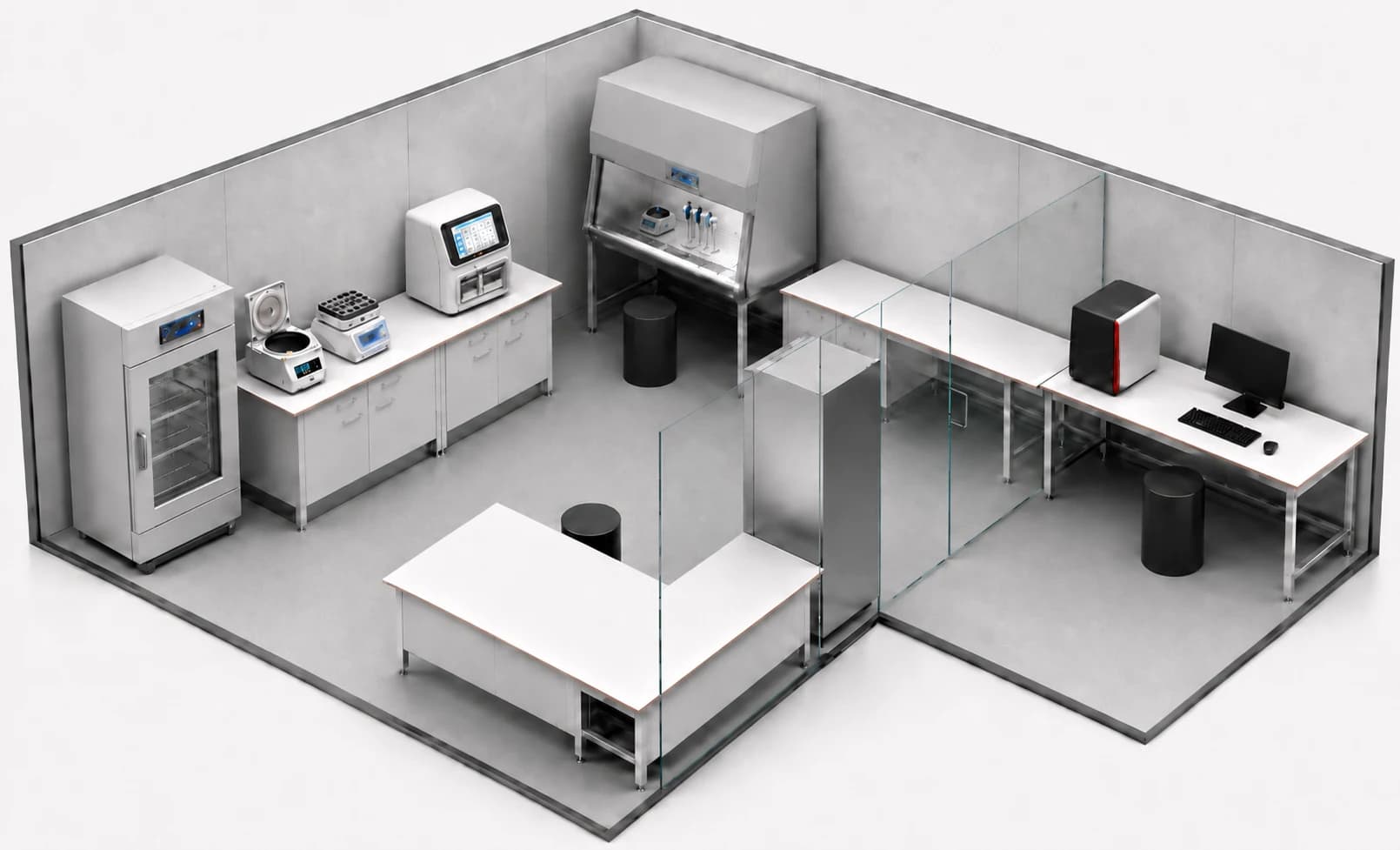
From the initial scope review to full activation, here's what to expect at each stage.
TAAG aligns country, plant, support level, and current laboratory readiness before activation.
The team reviews the required rooms, instruments, reagents, and base setup for the workflow.
Documents, procedures, and analyst training are reviewed to prepare the first run.
TAAG supports the first execution and helps stabilize the workflow in the plant environment. We also carry out a verification exercise at your facilities to keep results aligned with your own quality standards.
Resources
Documents · 03 filesOfficial documents and supporting materials in one place, generated on demand in your language.

Centralize your microbiology data across every plant, spot risk before it spreads, and join the growing network of facilities running on TxA.
Digitize your sampling process for total control and end-to-end traceability.
Streamline workflows and automate process controls for fully confident lab results.
Utilize predictive microbiology for comprehensive and preventive quality management.
Load your Environmental Monitoring Program, connected to every sampling point in your plant.
Your EMP, live on your own plant layout — AI flags risk point by point, before it becomes a positive.

Risk Prediction
High probability
Positive detected
Corrective action

Contact
You're never on your own. From scope and lab setup to onboarding, validation, and first run, I'll align the implementation path for your plant and stay with you through it.